🟦 Introduction: A Dua Born From Pain and Hope
Every Muslim faces moments of sadness. Sometimes the loss feels heavy. Sometimes a problem breaks your heart. In those moments, we search for a sentence that brings strength and peace.
One of the most comforting duas taught by Prophet Muhammad ﷺ is:
“Allahumma ajirni fi musibati…”
“O Allah, reward me in my calamity…”
This dua is simple. But its meaning carries deep healing. It teaches us how to think, how to hope, and how to trust Allah during trials.
In this article, we will explore the full dua, its meaning, benefits, hadith, Qur’anic foundation, and how to use it in daily life — in very simple English, for every Muslim.
🟦 The Full Dua (Arabic + Transliteration + English + Urdu)
📌 Arabic Text
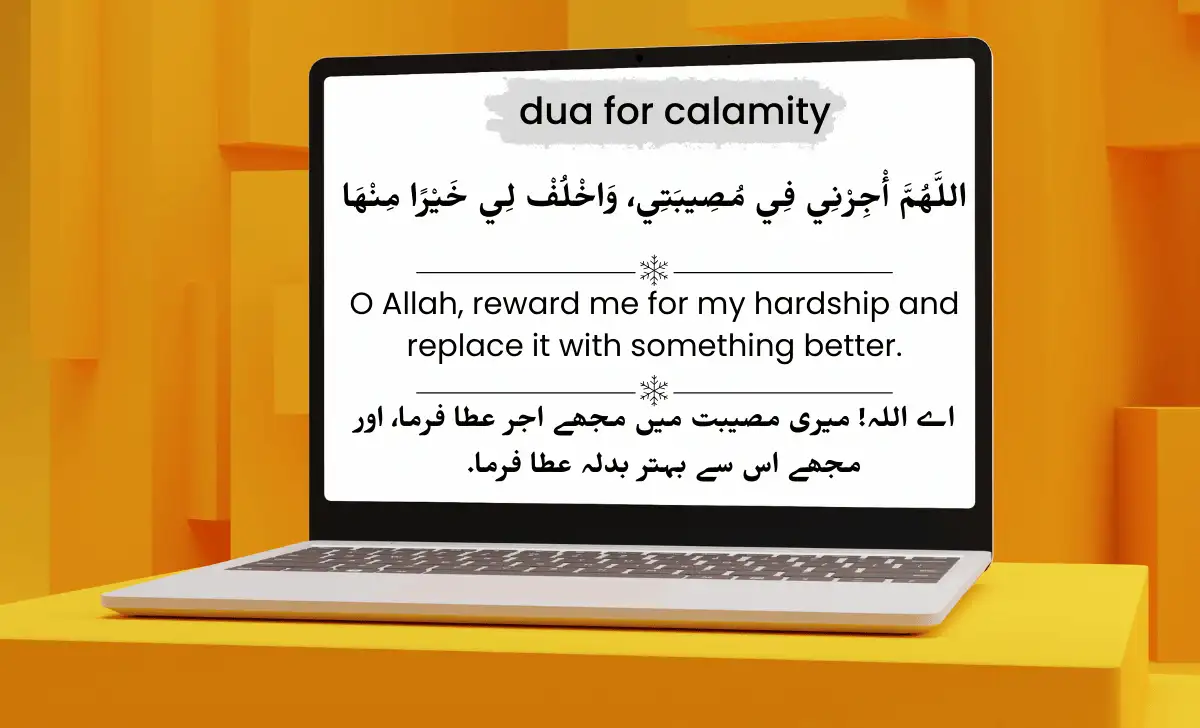
اللَّهُمَّ أْجِرْنِي فِي مُصِيبَتِي، وَاخْلُفْ لِي خَيْرًا مِنْهَا
📌 Transliteration
Allahumma ajirni fi musībati, wakhluf lī khayran minhā
📌 English Translation
“O Allah, reward me for my hardship and replace it with something better.”
📌 Urdu Translation
“اے اللہ! میری مصیبت میں مجھے اجر عطا فرما، اور مجھے اس سے بہتر بدلہ عطا فرما۔”
🟦 What This Dua Really Means
This dua has two beautiful requests:
1️⃣ “Allahumma ajirni fi musibati”
“O Allah, reward me in my hardship.”
Here we ask Allah:
- not to waste our pain
- to turn our sadness into reward
- to make our patience meaningful
- to give us spiritual strength
2️⃣ “Wakhluf li khayran minha”
“And replace it with something better.”
This part teaches deep hope. It reminds us that:
- Allah never closes one door without opening a better one.
- No loss is permanent for a believer.
- Better days are written — even if we cannot see them yet.
This dua is not only words. It is a mindset. A way of trusting Allah completely.
🟦 Qur’anic Foundation: Allah Replace Loss With Good
To understand this dua, we must look at Qur’anic guidance. Allah tells us many times that He tests us, but He also heals us.
📖 Qur’an Verse 1 — Tests Are Part of Life
Arabic
وَلَنَبْلُوَنَّكُمْ بِشَيْءٍ مِّنَ الْخَوْفِ وَالْجُوعِ وَنَقْصٍ مِّنَ الْأَمْوَالِ وَالْأَنفُسِ وَالثَّمَرَاتِ ۗ وَبَشِّرِ الصَّابِرِينَ
Transliteration
Wa lanabluwannakum bishay’in minal-khawfi wal-jū‘i wa naqsin minal-amwāli wal-anfusi wath-thamarāt; wa bash-shiris sābirīn.
English
“And We will surely test you with fear, hunger, loss of wealth, lives, and fruits. But give good news to the patient.” (Surah Al-Baqarah 2:155)
Urdu
“اور ضرور ہم تمہیں آزمائیں گے: خوف سے، بھوک سے، مال، جان اور پھلوں کی کمی سے۔ اور صبر کرنے والوں کو خوشخبری دے دیں۔”
This ayah shows: tests are normal. But reward is waiting for those who stay patient.
📖 Qur’an Verse 2 — After Hardship Comes Ease
Arabic
فَإِنَّ مَعَ الْعُسْرِ يُسْرًا • إِنَّ مَعَ الْعُسْرِ يُسْرًا
Transliteration
Fa inna ma‘al ‘usri yusrā. Inna ma‘al ‘usri yusrā.
English
“Surely, with hardship comes ease. Yes, with hardship comes ease.” (Surah Ash-Sharh 94:5–6)
Urdu
“بے شک مشکل کے ساتھ آسانی ہے۔ ہاں، مشکل کے ساتھ آسانی ہے۔”
This verse perfectly matches the dua. When something is taken from us, Allah promises to replace it with ease.
📖 Qur’an Verse 3 — Allah Gives Better Than What Is Lost
Arabic
وَمَن يَتَّقِ اللَّهَ يَجْعَل لَّهُ مِنْ أَمْرِهِ يُسْرًا
Transliteration
Wa man yattaqillāha yaj‘al lahu min amrihi yusrā.
English
“Whoever fears Allah, He will make his matters easy for him.” (Surah At-Talaq 65:4)
Urdu
“اور جو اللہ سے ڈرے، اللہ اس کے کاموں میں آسانی پیدا فرما دیتا ہے۔”
This verse supports the dua’s second part: Allah gives something better.
🟦 Why This Dua Is So Powerful
Here are simple but deep reasons this dua is life-changing:
✔ It turns pain into reward
Even grief becomes ibadah.
✔ It protects the heart from despair
You remember Allah still has a plan.
✔ It teaches emotional strength
Not by forcing strength — but by letting Allah handle your burden.
✔ It opens the door to a better future
Allah never replaces something with “equal.”
He replaces it with better.
✔ It was taught directly by Prophet Muhammad ﷺ
That makes it perfect for times of sadness.
🟦 When Should You Recite This Dua?
You can recite it:
- after hearing sad news
- after losing someone
- during sickness
- when facing rejection
- when a relationship ends
- when money problems appear
- when you feel disappointment
- when your heart feels heavy
There is no fixed time. Say it whenever pain touches your heart.
“What should I say when something bad happens in Islam?”
You can say: Allahumma ajirni fi musibati, wakhluf li khayran minha.
“What is the dua for loss or hardship?”
It is the dua taught by Prophet Muhammad ﷺ asking Allah for reward and a better replacement.
“Can I recite this dua for any difficulty?”
Yes. It is for all types of hardships — emotional, financial, personal, or physical.
🟦 Authentic Hadith About This Dua
This dua is found in Sahih Muslim, narrated by Umm Salamah (RA). Her story is one of the most beautiful examples of patience in Islam.
📌 Hadith (Sahih Muslim)
The Prophet ﷺ said:
“No Muslim is struck with a calamity and then says what Allah has commanded him…
‘Allahumma ajirni fi musibati wa akhlif li khayran minha,’
except that Allah will give him something better in exchange.”
(Sahih Muslim, Book of Remembrance)
This is the strongest evidence for the dua.
🟦 The Story Behind the Dua — A Real Lesson in Patience
Umm Salamah (RA) lost her husband Abu Salamah (RA), a noble companion. She was heartbroken, and at first, she wondered:
“How can Allah give me someone better than him?”
But she trusted the words of Prophet Muhammad ﷺ. She recited the dua with patience and faith.
Later, Allah replaced her loss with a blessing she never imagined:
👉 The Prophet Muhammad ﷺ himself proposed to her.
Allah gave her something far greater than what she lost — exactly as the dua promised.
This story teaches us:
- No loss is final.
- Allah replaces with better, not equal.
- What seems impossible to us is easy for Allah.
🟦 Deep Meaning of the Dua (Line-by-Line Tafsir Style)
Let’s break the dua into simple parts to understand its depth.
1️⃣ “Allahumma” — “O Allah”
You begin by calling your Lord with love and need.
This shows:
- humility
- trust
- closeness
You are not alone. Allah is listening.
2️⃣ “Ajirni” — “Reward me”
You are asking:
- “Ya Allah, make my pain valuable.”
- “Do not let this hardship be wasted.”
- “Turn this difficulty into something that raises my rank.”
This is a positive mindset.
Even pain becomes a blessing.
3️⃣ “Fi Musibati” — “In my calamity”
A musibah can be:
- loss
- heartbreak
- sickness
- failure
- financial difficulty
- family problems
- emotional pain
The dua applies to every type of hardship — big or small.
4️⃣ “Wakhluf li khayran minha” — “And give me better than what I lost”
This is the heart of the dua.
You ask Allah:
- not just to remove the pain
- not just to repair the loss
- but to replace it with something BETTER
Better health
Better spouse
Better job
Better peace
Better future
Better spiritual growth
Whatever Allah takes, He returns something stronger.
🟦 Psychological Benefits of This Dua (Backed by Islamic Wisdom)
✔ Helps you calm your mind
Because you shift focus from the problem to Allah’s plan.
✔ Builds emotional strength
You learn that every loss has meaning.
✔ Reduces anxiety
You trust that Allah will replace the loss with good.
✔ Encourages hope
You expect better days ahead.
✔ Teaches acceptance
Not every hardship is a punishment. Many are a path to reward.
✔ Strengthens iman
You learn to surrender to Allah without fear.
🟦 When Should You Recite This Dua?
Recite it anytime something hurts your heart.
Examples:
- After receiving sad news
- After losing a loved one
- After a breakup
- After job loss
- During sickness
- During disappointment
- When your plan fails
- When life feels heavy
There is no time limit. The dua is always open for you.
🟦 Signs That Allah Is Replacing Your Loss With Something Better
Sometimes Allah’s answer comes slowly.
Sometimes the signs are gentle.
Here are signals Allah may be sending:
✔ You feel unexpected peace
Even though the situation is difficult.
✔ You start seeing new opportunities
Doors you never noticed begin to open.
✔ You feel your faith becoming stronger
Hardship becomes a spiritual turning point.
✔ A better situation appears later
You look back and realize:
“SubhanAllah, this is better than what I lost.”
🟦 People Also Ask
1️⃣ What is the dua for patience during hardship?
The dua is: Allahumma ajirni fi musibati wakhluf li khayran minha.
2️⃣ What should I read when facing a calamity?
You can recite this dua and say Inna lillahi wa inna ilayhi raji’un.
3️⃣ Can I recite this dua for emotional pain?
Yes, it applies to all types of pain — emotional, physical, or financial.
4️⃣ Did the Prophet ﷺ teach this dua?
Yes. It is recorded in Sahih Muslim from Umm Salamah (RA).
5️⃣ Can I recite it for others?
Yes. You may ask Allah to reward someone else in their hardship.
🟦 A Short Emotional Story
There was a young woman who lost her job.
She cried every night.
She kept asking:
“Why did this happen to me?”
One day her friend told her this dua:
Allahumma ajirni fi musibati wakhluf li khayran minha.
She began reciting it daily.
Weeks passed.
Suddenly she received a job offer — one she had never even dreamed of.
Better salary.
Better environment.
Better peace.
She later said:
“If Allah had not closed that first door, I would have never seen this blessing.
Truly, this dua brings better things than we expect.”
This is the reality of Allah’s promise:
Hardship is not the end. It is a beginning.
🟦 Conclusion
The dua Allahumma ajirni fi musibati is more than a sentence.
It is a bridge between your pain and Allah’s mercy.
It reminds you:
- Allah sees your tears
- Allah hears your heart
- Allah knows your struggle
- Allah will replace your loss with something better
Your only job is to trust Him.
🟦 Final Deep Reflection: A Message to the Heart
Every person reading this dua is carrying some kind of pain.
Maybe you lost someone.
Maybe life changed suddenly.
Maybe your heart feels tired.
But remember this:
Allah never takes something from you unless He plans to give you something better, stronger, and more beautiful.
When you say:
اللَّهُمَّ أْجِرْنِي فِي مُصِيبَتِي، وَاخْلُفْ لِي خَيْرًا مِنْهَا
you are telling Allah:
- “Ya Allah, I trust You.”
- “I believe You will take care of me.”
- “I know You never leave Your servant alone.”
Your pain is not wasted.
Your tears are not ignored.
Your patience is not forgotten.
This dua is not only for the tongue.
It is for the heart.
Say it with sincerity — and watch how Allah writes a better chapter for you.
🟦 Summary
| Topic | Summary |
|---|---|
| Dua Name | Allahumma Ajirni Fi Musibati |
| Full Arabic | اللَّهُمَّ أْجِرْنِي فِي مُصِيبَتِي، وَاخْلُفْ لِي خَيْرًا مِنْهَا |
| Meaning | “O Allah, reward me in my hardship and replace it with something better.” |
| Source | Sahih Muslim – Hadith of Umm Salamah (RA) |
| Purpose | To seek reward, patience, and a better replacement after loss |
| Best Time to Recite | After hardship, sad news, loss, heartbreak, failure |
| Benefits | Emotional healing, reward, hope, spiritual strength, better blessings |
🟦 Final Conclusion: The Dua That Changes Hearts
Life will always bring challenges.
But Allah also gives us words that turn hardship into hope.
This dua teaches us:
- to be patient
- to trust Allah
- to expect goodness
- to surrender our pain to the One who heals
Whenever you feel overwhelmed, just place your hand on your heart and whisper:
“Allahumma ajirni fi musibati, wakhluf li khayran minha.”
And believe — truly believe — that Allah will send you something better than what you lost.
Because He always does.
And He never breaks His promise.
FAQs:
Say: Allahumma ajirni fi musibati wakhluf li khayran minha.
It means: “O Allah, reward me in my hardship and replace it with something better.”
It is found in Sahih Muslim, in the chapter of remembrance and supplication.
Yes. It is powerful for emotional pain and sadness.