Have you ever felt exhausted even after a full night of sleep? We often search for peace in wealth, relationships, or entertainment, only to find our hearts still feeling hollow. True contentment cannot be bought or manufactured; it must be awakened.
Here is why this matters: the human soul originates from a divine source, which means it will never find permanent rest in temporary, worldly things. The Quran provides a definitive cure for this existential restlessness, summarizing the secret to a peaceful life in a single, powerful sentence.
Ala Bizikrillahi Tatmainnal Quloob: Meaning and Origin
Ala bizikrillahi tatmainnal quloob translates to “Unquestionably, by the remembrance of Allah hearts are assured.” Found in Surah Ar-Ra’d (Chapter 13, Verse 28), this verse is a profound reminder that spiritual peace comes solely through maintaining an active connection with God.
To truly grasp the beauty of Surah Ar-Ra’d, Ayah 28, we must look at its exact phrasing. This verse guarantees that the anxiety and turbulence of life fade away when the soul reconnects with its Creator through continuous Zikr.
Quranic Verse: Finding Peace Through Remembrance
The verse “Allazina amanu wa tatmainnu qulubuhum bizikrillahi ala bizikrillahi tatmainnal quloob” serves as a divine promise for those seeking emotional stability. It highlights that true tranquility is not found in material wealth but is a direct result of remembering the Creator.
Multilingual Proof Format:
The Arabic Text
الَّذِينَ آمَنُوا وَتَطْمَئِنُّ قُلُوبُهُم بِذِكْرِ اللَّهِ ۗ أَلَا بِذِكْرِ اللَّهِ تَطْمَئِنُّ الْقُلُوبُ
Transliteration
Alladhina amanu wa tatmainnu qulubuhum bidhikrillahi, ala bidhikrillahi tatmainnal quloob.
English Translation
“Those who have believed and whose hearts are assured by the remembrance of Allah. Unquestionably, by the remembrance of Allah hearts are assured.”
Urdu Translation
“جو لوگ ایمان لائے اور جن کے دل اللہ کے ذکر سے اطمینان حاصل کرتے ہیں۔ خبردار! اللہ کا ذکر ہی وہ چیز ہے جس سے دلوں کو اطمینان نصیب ہوتا ہے۔”
Hindi Translation
“जो लोग ईमान लाए और जिनके दिल अल्लाह के ज़िक्र (याद) से संतुष्ट होते हैं। निस्संदेह, अल्लाह के ज़िक्र से ही दिलों को शांति मिलती है।”
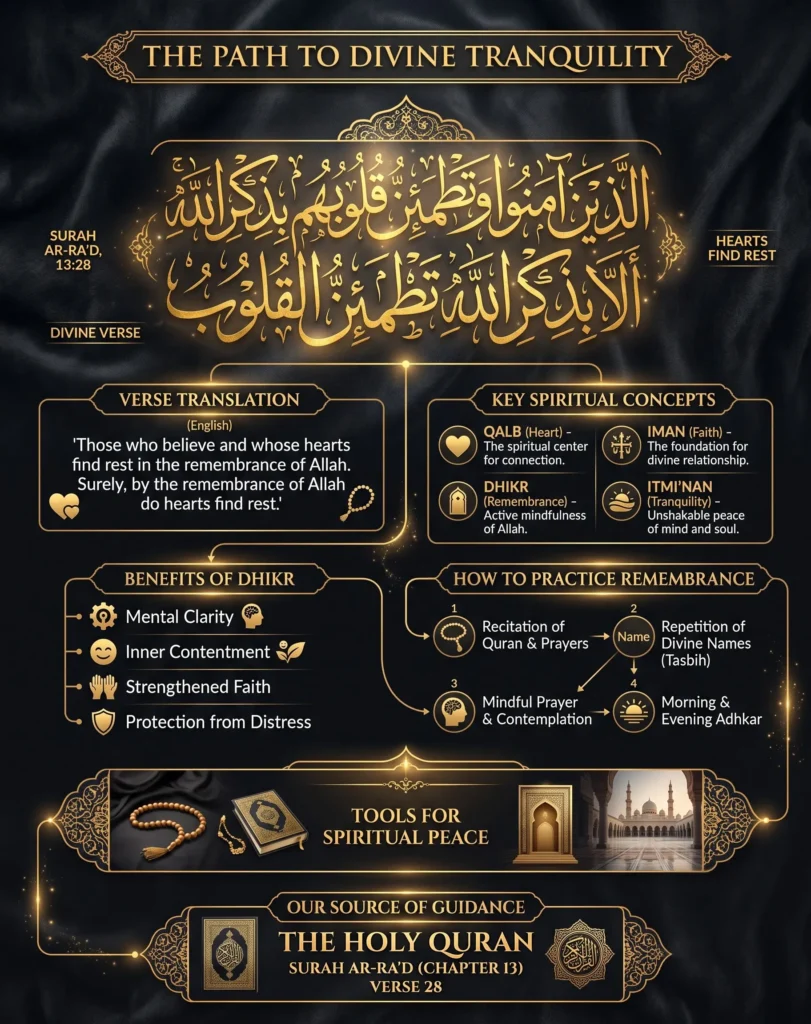
Let’s understand the real meaning word by word. “Ala” is a powerful Arabic particle used to grab attention—meaning “Listen closely!” or “Without a doubt!” “I means through the remembrance of Allah. “Tatmainnu” comes from a root word meaning absolute tranquility after a state of chaos. Finally, “Al-Quloob” refers to the hearts. God is telling us that the ultimate anchor for a chaotic mind is the active, conscious remembrance of Him.
Tafseer and Classical Scholarly Depth
Classical scholars of Islam universally agree that a heart disconnected from God remains in constant turmoil. Engaging in Zikr brings immediate spiritual stability, removing the doubts and fears that naturally plague the human mind.
Imam Ibn Kathir, in his renowned Tafseer, explains this verse beautifully. He states that it is the right of the heart to find comfort in Allah. When a person praises God, the heart settles because it recognizes its Master. The agitation of the human condition is essentially a state of spiritual homesickness. The moment the tongue and heart align in the remembrance of Allah, the soul feels at home, and the fear of worldly loss diminishes.
This becomes important when you look at how fragile our emotional states can be. If you ever feel your faith wavering or your emotions spiraling, pairing your Zikr with a prayer for steadfastness, such as rabbana la tuzigh quloobana, builds an unbreakable spiritual shield around your mind and soul.
Islamic Psychological Resilience: A New Paradigm
Islamic psychological resilience teaches that while hardship is an inevitable part of life, emotional devastation is not. The remembrance of Allah acts as a cognitive anchor, stopping the mind from spiraling into anxiety and grounding your emotions in divine trust.
Modern psychology frequently discusses the concept of “resilience”—the ability to bounce back from trauma or stress. However, Islamic psychological resilience goes a step further. It does not just teach us to endure pain; it teaches us how to transform pain through Tawakkul (trust in God). When you internalize “Ala bizikrillahi tatmainnal quloob,” you shift your focus from the massive size of your problems to the infinite power of your Creator.
The heart, when left to its own devices, falls prey to negativity bias, constantly worrying about the future or regretting the past. Zikr interrupts this destructive psychological loop. It pulls you into the present moment, reminding you that Allah is in control right now. This is the ultimate form of mindfulness. It trains your brain to default to peace rather than panic when faced with a crisis.
Powerful Benefits of This Verse
Reciting this powerful verse transforms your mental and spiritual state from the inside out. The benefits range from instant anxiety relief and emotional regulation to strengthening your foundational faith and protecting your mind against negative whispers.
- Eradicates Anxiety and Depression: The verse acts as a spiritual balm. Regular recitation lowers the emotional temperature of a panicked mind, replacing irrational fears with calm certainty.
- Builds Emotional Immunity: Just as vitamins boost your physical immune system, the constant remembrance of Allah builds an emotional barrier, making you less reactive to insults, financial loss, or personal setbacks.
- Invites Divine Light (Noor): A heart engaged in Zikr becomes polished and reflective. It is able to perceive truth from falsehood much more clearly.
- Guards Against Waswas: Satanic whispers and intrusive thoughts thrive in an empty, distracted mind. Filling your cognitive space with the name of Allah evicts these negative intrusions immediately.
Complementary Hadith on the Power of Zikr
The Prophet Muhammad (peace be upon him) beautifully illustrated the contrast between a life filled with Zikr and a life without it. Remembering Allah is the defining factor between a spiritually alive, resilient heart and a dead one.
In Sahih Al-Bukhari (Hadith 6407), Abu Musa Al-Ash’ari narrated that the Prophet (PBUH) said:
“The example of the one who remembers his Lord in comparison to the one who does not remember his Lord is that of the living and the dead.”
A heart without Zikr is spiritually deceased, easily crushed by the weight of worldly problems. But a heart pulsating with Zikr is alive, capable of absorbing shocks and navigating trials with grace. However, establishing this habit requires divine facilitation. We cannot rely solely on our own willpower. This is why the Prophet (PBUH) constantly modeled asking Allah for help in His remembrance after every obligatory prayer, acknowledging that even the ability to remember God is a gift from Him.
Your Daily Wazifa:
To experience the full calming effect of this verse, you must make it a deliberate daily spiritual habit. Reciting it intentionally during moments of stress immediately grounds your racing thoughts and invites divine tranquility into your chest.
If you are dealing with severe restlessness, overthinking, or a heavy heart, implement this specific Wazifa into your daily routine:
- Perform ablution (Wudu) and sit in a quiet place.
- Place your right hand over your heart.
- Recite Durood Shareef (Salawat) 3 times.
- Recite “Ala bizikrillahi tatmainnal quloob” 41 times with deep focus, feeling the meaning of the words entering your chest.
- Close with Durood Shareef 3 times.
- Take a deep breath and exhale, releasing your worldly anxieties to Allah.
Make this a consistent practice after Fajr or Isha prayers, and you will notice a profound shift in your psychological resilience within days.
People Also Ask:
It is located in Surah Ar-Ra’d, which is the 13th chapter of the Holy Quran. The exact location is Ayah (verse) number 28.
While the Sunnah does not restrict it to a specific number, Islamic scholars and spiritual guides highly recommend reciting it 41 times daily. Placing your right hand on your chest while reciting helps physically ground your anxiety.
Itmi’nan does not just mean happiness; it means a deep, unshakable serenity and psychological stability. It is the feeling of absolute safety that remains even when the outside world is chaotic.
Yes, you can recite this specific verse from memory for the purpose of Zikr and seeking comfort even if you are not in a state of Wudu, though having Wudu amplifies the spiritual benefit.