We live in an era of constant mental noise. We overthink, we worry, and we battle our own inner critics every single day. But what if the ultimate cure for chronic anxiety and spiritual burnout was revealed over 1,400 years ago? Let’s explore a profound spiritual state where the mind finally stops racing, completely anchored in divine peace.
What Does Ya Ayyuhan Nafsul Muthmainnah Mean?
“Ya Ayyuhan Nafsul Muthmainnah” translates to “O reassured soul.” Found in Surah Al-Fajr (verses 27-30), it represents the highest level of spiritual and psychological peace in Islam. It describes a believer who is completely content with God’s decree, entirely free from crippling anxiety, doubt, and fear.
The Multilingual Proof Format
Arabic:
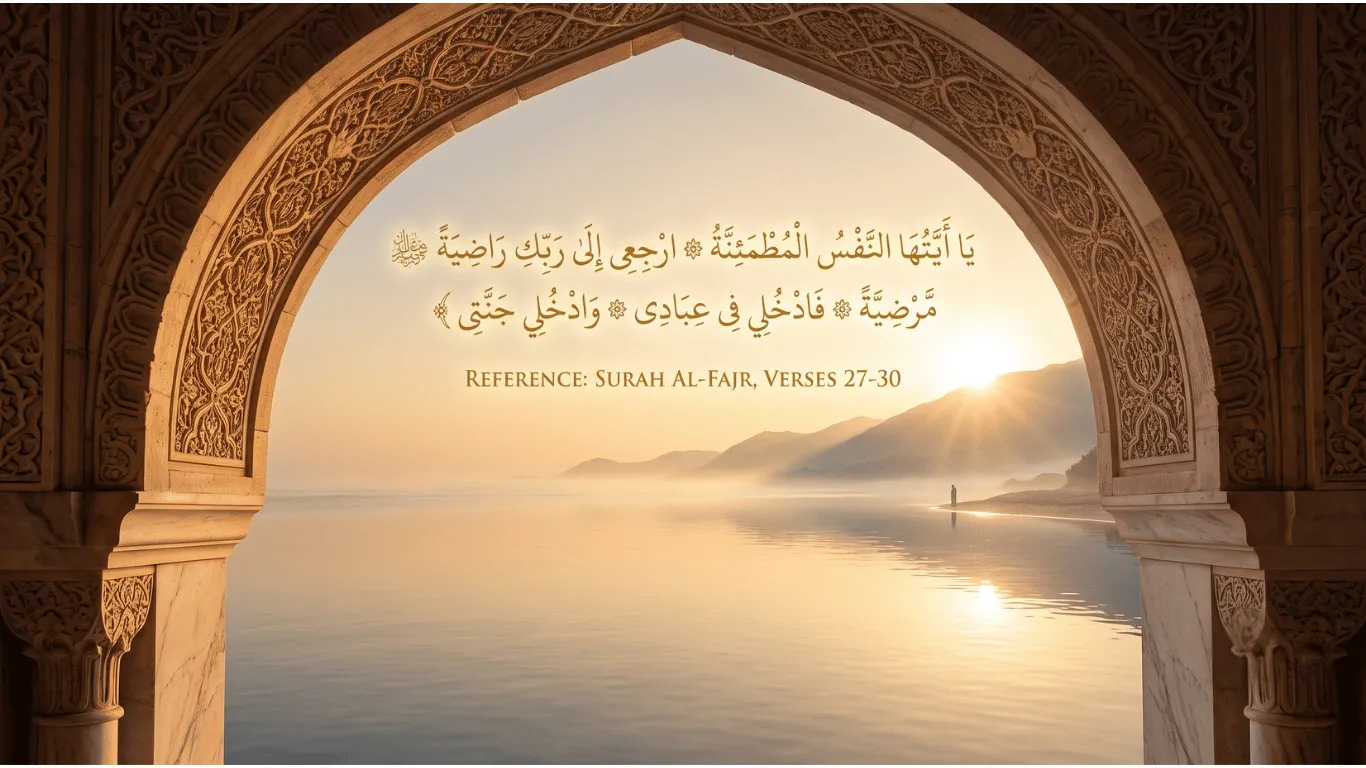
يَا أَيَّتُهَا النَّفْسُ الْمُطْمَئِنَّةُ * ارْجِعِي إِلَىٰ رَبِّكِ رَاضِيَةً مَّرْضِيَّةً * فَادْخُلِي فِي عِبَادِي * وَادْخُلِي جَنَّتِي
Transliteration: Yā ayyatuhā al-nafs al-muṭma’innah. Irji’ī ilā rabbiki rāḍiyatan marḍiyyah. Fadkhulī fī ‘ibādī. Wadkhulī jannatī.
English Translation: “O reassured soul, Return to your Lord, well-pleased and pleasing [to Him], And enter among My [righteous] servants, And enter My Paradise.”
Urdu Translation:
اے اطمینان والی جان! اپنے رب کی طرف لوٹ آ، اس حال میں کہ تو اس سے راضی ہو اور وہ تجھ سے راضی ہو۔ پھر میرے خاص بندوں میں شامل ہو جا۔ اور میری جنت میں داخل ہو جا۔
Hindi Translation:
ऐ इत्मीनान (शांति) वाली जान! अपने रब की तरफ लौट आ, इस हाल में कि तू उससे राज़ी हो और वह तुझसे राज़ी हो। फिर मेरे (नेक) बंदों में शामिल हो जा। और मेरी जन्नत में दाखिल हो जा।
Let’s understand the real meaning. When God addresses the soul directly, it is a mark of ultimate honor. This is not a soul that lived a life entirely free of hardship; rather, it is a soul that endured the trials of life without losing its trust in the Creator.

Tafseer Ibn Kathir and Hadith
Classical scholars explain these verses as the divine greeting given to believers at death and on Judgment Day. According to Tafseer Ibn Kathir, the angels deliver this message to wrap the departing soul in absolute safety, confirming God’s mutual love and pleasure.
This becomes important when you look at the human fear of the unknown. Death and the afterlife are inherently frightening to the human mind. However, renowned Islamic scholars, drawing from the authentic Hadith, provide a deeply comforting context. The Prophet Muhammad (peace be upon him) described the soul’s transition in a famous narration regarding the Angel of Death. When the Angel of Death approaches a righteous believer, he sits at their head and gently says, “O good and peaceful soul, come out to the forgiveness from Allah and His pleasure.”
The soul then flows out as smoothly as a drop of water flowing from a jug. The psychological reassurance here is profound: the end of worldly existence is not a violent severing, but a joyful homecoming to the Most Merciful.
Quranic Psychology
Islamic psychology categorizes the human mind into three distinct stages: the impulsive self (Nafs al-Ammarah), the self-critical mind (Nafs al-Lawwamah), and finally, the tranquil soul (Nafs al-Mutma’innah). Reaching this final state requires intentional spiritual habits that replace negative thought loops with God-consciousness.
Here’s why this matters. We often view spiritual perfection as something unattainable, but classical scholars like Imam Al-Ghazali in his monumental work, Ihya ‘Ulum al-Din (The Revival of the Religious Sciences), mapped out this psychological progression beautifully.
- Nafs al-Ammarah (The Impulsive Self): Mentioned in Surah Yusuf (12:53), this is the lowest state of the mind. It is driven purely by ego, base desires, and immediate gratification. It is the voice that encourages destructive behavior.
- Nafs al-Lawwamah (The Self-Reproaching Self): Mentioned in Surah Al-Qiyamah (75:2), this is the awakened conscience. When you feel guilt after making a mistake or experience anxiety over your spiritual state, you are in this stage. It is a necessary, albeit uncomfortable, phase of growth.
- Nafs al-Mutma’innah (The Reassured Soul): The final stage, where the mind has been disciplined. The internal civil war ends. The soul trusts God’s timing, accepts His decree, and finds deep, unshakeable tranquility.
Transitioning through these stages is essentially a spiritual habit loop. It requires acknowledging the negative impulses, utilizing the guilt of the self-reproaching mind to course-correct, and seeking refuge in faith until peace is established. Those interested in managing modern anxiety through faith can find profound relief in understanding that the inner struggle is a recognized and necessary part of the journey toward ultimate peace.
Achieving a Reassured Soul Today
To cultivate a reassured soul, modern believers must practice intentional daily mindfulness. This includes consistent Dhikr (remembrance of Allah), expressing deep gratitude during hardships, and grounding oneself in daily prayers to quiet the mind’s internal chaos.
Now let’s connect this to daily life. The philosophy of Nafs al-Mutma’innah must translate into actionable steps. You cannot simply wish away a racing mind; you must train it.
- Mindful Dhikr (Remembrance): As the Quran states in Surah Ar-Ra’d (13:28), “Verily, in the remembrance of Allah do hearts find rest.” This is the core mechanism for achieving tranquility.
- The Wazifa of Surah Al-Fajr: Many spiritual mentors recommend reciting the final verses of Surah Al-Fajr daily, particularly after the Fajr prayer or before sleeping. Doing so acts as a psychological anchor, reminding you of your ultimate destination and rendering daily stresses insignificant.
- Cognitive Reframing through Dua: When negative thoughts arise, immediately replacing them with prayers for guidance shifts the mind from panic to reliance on God. Establishing daily habits for a reassured soul builds a mental fortress against the despair of the modern world.
People Also Ask:
There is no fixed number of times prescribed in the authentic Sunnah for reciting this specific verse as a daily ritual. However, scholars highly recommend reciting it frequently, especially during moments of anxiety or grief, to remind the heart of God’s ultimate promise of peace.
Reciting Surah Al-Fajr provides deep spiritual perspective. It reminds the reader of the fleeting nature of worldly power (by citing ancient civilizations), the reality of the Day of Judgment, and the ultimate reward of absolute peace for those who remain steadfast in their faith.
The phrase “Nafsul Muthmainnah” is found in the final verses of Surah Al-Fajr (Chapter 89). Specifically, it is verse 27, which is followed by verses 28, 29, and 30, describing the soul’s joyful entry into Paradise.
Yes. From an Islamic psychological perspective, meditating on the meaning of “O reassured soul” helps ground a believer. It shifts focus away from uncontrollable worldly stressors and refocuses the mind on the ultimate goal: attaining God’s pleasure and eternal tranquility.
Finding mental clarity is a journey of actively retraining your mind and heart to rely on the Creator. If you are struggling with a racing mind, chronic overthinking, or mental fatigue, it is time to take the next step in your psychological and spiritual journey. Head over to our psychology channel and watch our upcoming video exploring the 3 thoughts that destroy brain cells—and learn exactly how to break those negative mental patterns to achieve a truly reassured soul.