Imagine coming home after a demanding, exhausting workday. The world expects you to keep running, scrolling, or worrying about tomorrow, but your Creator is calling you to pause. The Prophet Muhammad (ﷺ) beautifully stated, “Whoever offers Isha in congregation, it is as if he spent half the night in worship” (Sahih Muslim 656a). That is the immense power of the night prayer. It is not a burden; it is the ultimate spiritual wind-down.
If you are a newly practicing Muslim, a revert, or simply a busy professional trying to balance modern life with faith, the evening prayer can sometimes feel overwhelming. You might hear different numbers—some say 17 rakats, others say less—and that confusion creates a psychological barrier.
Here is why this matters: Islam is built on ease, not hardship. Today, we are going to look at the exact, simplified 9-rakat sequence of the Isha prayer. This structure fulfills your divine obligation, perfectly follows the Sunnah, and helps you disconnect from workplace stress to prepare your soul for restful sleep.
What is Salat-ul-Isha? The Divine Evening Reset
The Isha prayer is the fifth and final obligatory daily prayer, performed after the twilight has faded from the sky and before the time of Fajr begins. It is explicitly named in Surah An-Nur (24:58) of the Quran as “Salat-ul-Isha,” establishing its divine mandate as a time of privacy, rest, and connection with Allah.
This becomes important when you look at how Islam structures human psychology. By making Isha mandatory right before our sleeping hours, Allah gives us a framework to empty our hearts of worldly anxieties. When you stand on the prayer mat, you are leaving the emails, the office politics, and the daily hustle behind. You are closing your day exactly how you started it—in submission.
The Spiritual Wind-Down Sequence
How Many Rakats in Isha Namaz?
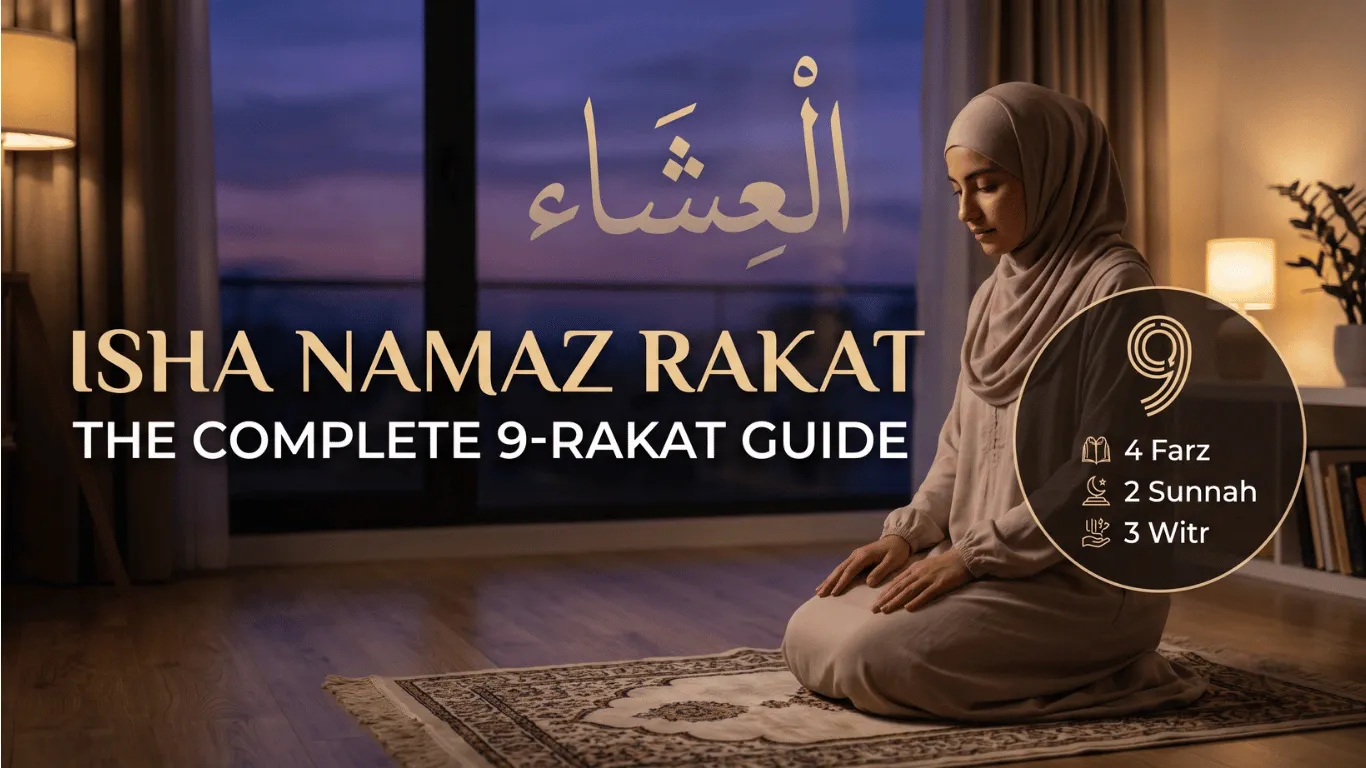
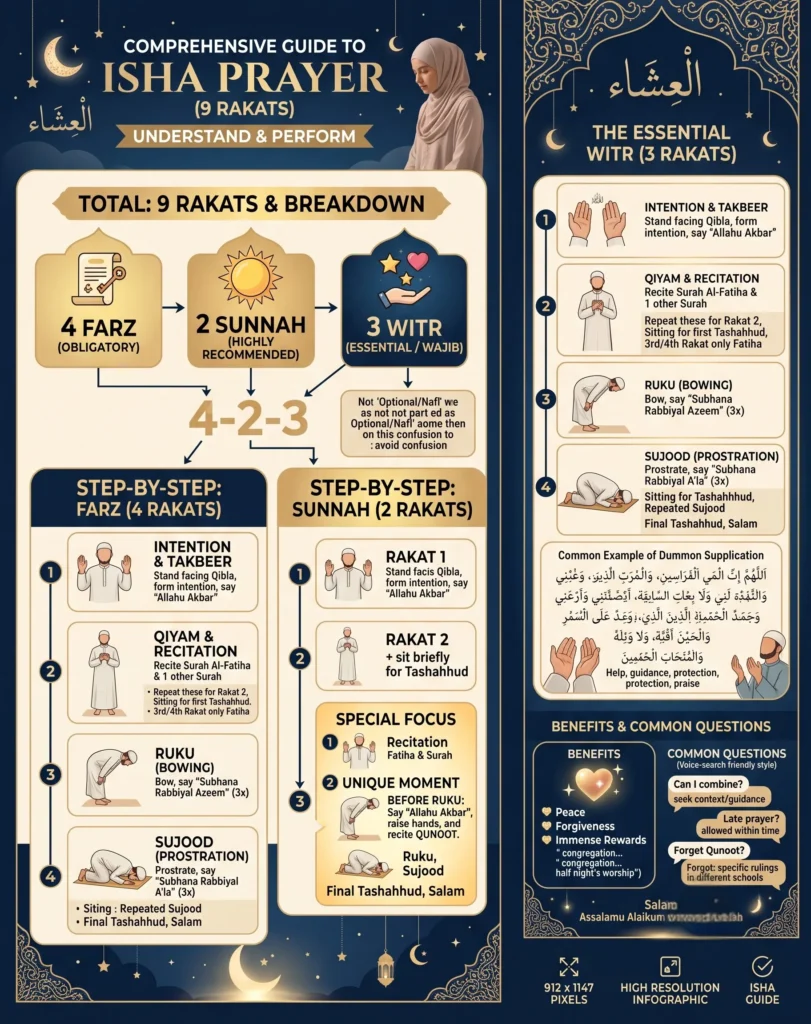
The essential Isha prayer consists of exactly 9 rakats. This step-by-step breakdown includes 4 Farz (mandatory rakats), 2 Sunnah Muakkadah (highly recommended rakats), and 3 Witr (the necessary completion of the night). Praying this sequence fulfills your obligation completely.
Many Muslims in South Asian communities (speaking Urdu and Hindi) often grow up hearing that Isha is 17 rakats. While praying 17 rakats (which includes various optional Nafl prayers) is deeply rewarding if you have the time and energy, it is not strictly required. If you are exhausted after a long day, focusing purely on these core 9 rakats removes the psychological barrier of an endlessly long prayer while securing the full reward.
1. The 4 Farz (Mandatory Rakats)
The 4 Farz of Isha are the absolute core of the night prayer. These four units are mandatory upon every adult Muslim. If you are praying in a congregation, the Imam will recite the Quran out loud during the first two rakats, and silently during the last two.
If you are praying alone at home, you will also pray these 4 rakats, ensuring your intention (niyyah) is set for the Farz of Isha. Fulfilling these four rakats is what lifts the religious obligation off your shoulders.
2. The 2 Sunnah Muakkadah (Highly Recommended)
After the mandatory prayer, there are 2 Sunnah Muakkadah rakats. These are highly emphasized practices of the Prophet Muhammad (ﷺ). While skipping them does not invalidate your Farz, performing them consistently builds a fortress of spiritual protection around your obligatory prayers.
Let’s understand the real meaning of Sunnah Muakkadah. These are actions the Prophet (ﷺ) rarely missed. When you pray these two short rakats, you are actively linking your daily habits to the beloved lifestyle of the Messenger of Allah, earning his intercession and immense extra reward.
3. The 3 Witr (The Essential Night Completion)
The 3 Witr rakats act as the seal of your daily prayers. Witr literally means “odd number,” and it is an essential (Wajib) prayer to close the night. The Prophet (ﷺ) heavily emphasized this, stating in Sahih Al-Bukhari (Hadith 990) to make Witr the final prayer before sleep.
Confusion often surrounds how to pray Witr. It is prayed similarly to a 3-rakat Maghrib prayer, but with one major difference: in the third rakat, after reciting Surah Al-Fatiha and another surah, you raise your hands to your ears, say “Allahu Akbar,” fold them again, and recite the Dua Qunoot before bowing (ruku). This beautiful supplication is a profound moment to ask Allah for guidance, health, and protection.
| Prayer Type | Number of Rakats | Status in Islam |
| Farz | 4 Rakats | Mandatory obligation |
| Sunnah | 2 Rakats | Highly emphasized practice |
| Witr | 3 Rakats | Essential (Wajib) closing prayer |
| Total | 9 Rakats | Complete Core Isha Prayer |
Overcoming Evening Exhaustion
Now let’s connect this to daily life. The modern professional experiences a massive cognitive load by 8:00 PM. The brain is tired. The easiest thing to do is collapse on the couch and scroll through a phone. This is a negative habit loop triggered by exhaustion.
We can replace this with a Spiritual Habit Loop. Treat wudu (ablution) not as a chore, but as a physical and mental cleansing of the day’s stress. The cool water physically lowers your heart rate. When you step onto the prayer mat for those 9 rakats, focus entirely on the physical movements—the standing, the bowing, the prostration.
You are actively discharging the day’s negative energy into the earth during Sujood. By the time you finish your 3 Witr, your nervous system is calmed, your mind is detached from screens, and you are in a state of purity, ready for truly restorative sleep. Just as you anchor the middle of your workday using the Zuhar namaz rakat, the 9 rakats of Isha anchor your night.
People Also Ask:
Yes, praying only the 4 Farz rakats fulfills your basic Islamic obligation for the Isha prayer. If you are severely ill, traveling, or completely exhausted, completing the 4 Farz ensures you have not missed the mandatory prayer. However, you should still attempt to pray the 3 Witr before sleeping.
You pray two rakats and sit for the first Tashahhud. Then you stand up for the third rakat, recite Surah Al-Fatiha and another Surah. Before bowing, raise your hands, say Allahu Akbar, fold them again, and recite Dua Qunoot. Then complete the prayer normally.
Yes, delaying Witr until right before you sleep is highly recommended by the Prophet (ﷺ). If you plan to wake up in the last third of the night, you can even delay your Witr to follow your Tahajjud prayer, pairing it beautifully with your Tahajjud ki Dua.
If you are a revert or still learning Arabic, do not let this stop you from praying Witr. You can recite “Rabbana atina fid-dunya hasanatan wa fil ‘akhirati hasanatan waqina ‘adhaban-nar“ (Our Lord, give us good in this world and good in the Hereafter, and save us from the punishment of the Fire) while you continue to memorize the full Dua Qunoot.
Read Next: How to Wake Up for Tahajjud Without Feeling Tired.